Spurred on by the gift of a surgery table from Dr. Karl Gilchrist the May edition of the Chronicle turned to the District’s Community Archives to introduce the Ranfurly Private Hospital. Serendipitously, several of the Coach House Museum’s staff had visited the exhibition Remarkable Remedies: A Journey Through Medical History shown at the City Library during Palmerston North’s Heritage Festival in March and April. With Ranfurly Hospital, its histories and medical collections in mind, The Coach House Museum invited colleagues from the David Warnock Medical Museum to reprise their exhibition in Feilding.
The Medical Museum eagerly accepted the invitation. Making the most of the extra display cases, the exhibition now includes additional material that couldn’t be shown in Palmerston North. Most haven’t been displayed for a long time. New storylines have surfaced from recent research and have been added. These features offer a new dynamic for Feilding and for visitors from Palmy.
The oldest objects with a New Zealand provenance include a medical kit used during the New Zealand Wars (1845-1972) and a ship’s medicine chest from the 1860s when the early steamers plied the coastal run. It is complete with original bottles of medicine containing things like potassium bromide, given as a sedative, and bismuth carbide, used to treat indigestion. The ship’s medicine chest and the Medical Kit belonging to surgeon Dr. Alan Douglas are both new additions to the exhibition.
It was Alan Douglas’ kit that opened a new theme related to medical practice in time of war, has emerged for this exhibition. In 1941, Douglas joined the RAMC before being transferred to the New Zealand Medical Corps in which he served in the Middle East and Italy until the end of the war.
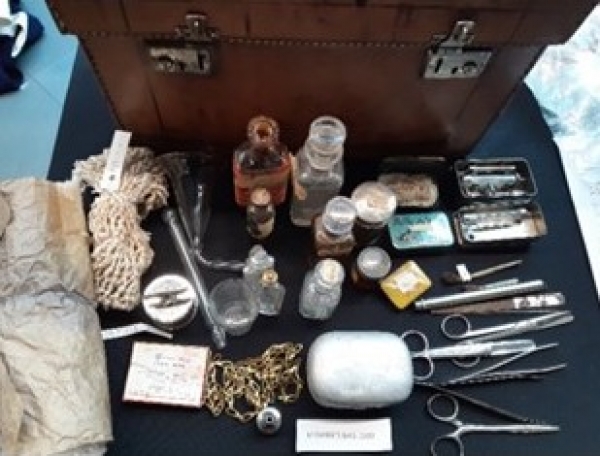 Mid-wife's Bag, 1920s
The selection for the Coach House Museum includes items with direct association to Palmerston North and the Manawatū:
The backstory of the prosthetic leg is a tale of valour and ingenuity. It is a “Remarkable Remedy” that transformed the world for the betterment for all people needing prosthetic solutions.
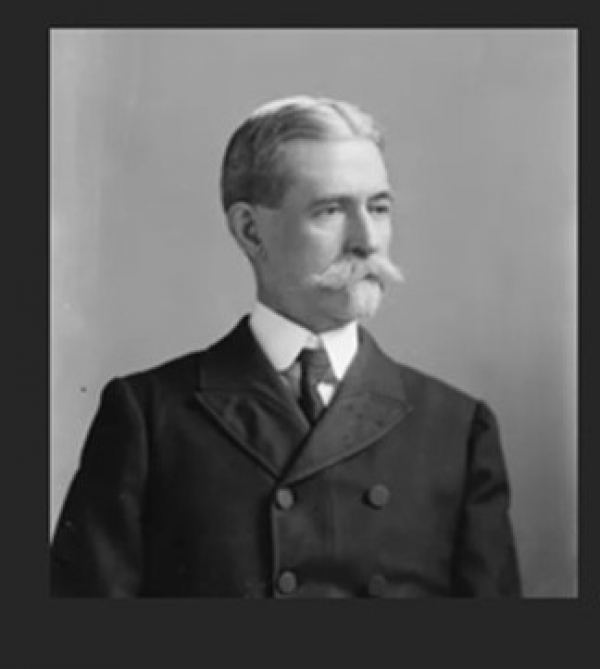 J.E. Hanger, c1902
The founder of J.E. Hanger & Co., James Edward Hanger, was gravely wounded in the American Civil War in 1861 and had his leg amputated 7 inches below the hip. Knowing how fellow soldiers made do with ‘peg legs’ and as a trained engineer, he turned his efforts to helping others in similar situations. By the time he died in 1919, he had built a thriving company with workshops in Europe and America. Today, Hanger Inc. is a billion-dollar company, helping over half a million patients annually. It continues to honour the history of service and innovation that James Edward modelled and remains committed to the core values of integrity, patient-focused outcomes, collaboration, and innovation.
In case you are wondering - Yes! the 100 left prosthetic eyes are included in the exhibition.
The exhibition will continue at the Coach House Museum for a couple of months, including during school holidays.
Don’t miss it.
______________________________________
Interesting background and context
The Museum was founded in 1980 by Dr. David Warnock, an ophthalmologist who practised in Palmerston North.
The Museum was generously supported by the Palmerston North Hospital and its staff for 43 years. However, in 2023 the hospital needed the land to provide a sub-station for the much-needed new mental health unit.
While the collection of approximately 10,000 objects is now in off-site storage, the Museum’s volunteers remain committed to caring for the fragile and historically significant objects that say much about the history of medical technology in New Zealand and the people who gave, or collected, the objects. The links to Palmerston North are etched deep into fabric of the collection.
Our volunteers maintain ‘pop-up’ exhibitions throughout the hospital. These provide much appreciated moments of respite for patients, families and hospital staff.
On the first day of the exhibition, one visitor recalled her first encounter with such ‘pop- ups’. Shortly after the birth of her first baby – knowing that he was in good hands – she and her husband took a walk and discovered two cabinets of vintage medical instruments. “It was such an unexpected surprise”, she said to other visitors and library staff who had gathered to listen.
Volunteers also give talks to community groups and service organisations.
In December 2024 Micki Tyler contributed oral histories in conversations with Stuart Birk on Manawatū People’s Radio. These are available on the Heritage Manawatū site.
As the Museum’s Trust Board Chair, Dr. John Bourke, says:
As the Medical Museum’s long contribution to the preservation of medical technology and history attests: this is a “keeping place” where the community are partners in interpretating our heritage for the past, present and future. Only by working together to research, document, exhibit and communicate will we be successful in preserving our collective knowledge”.