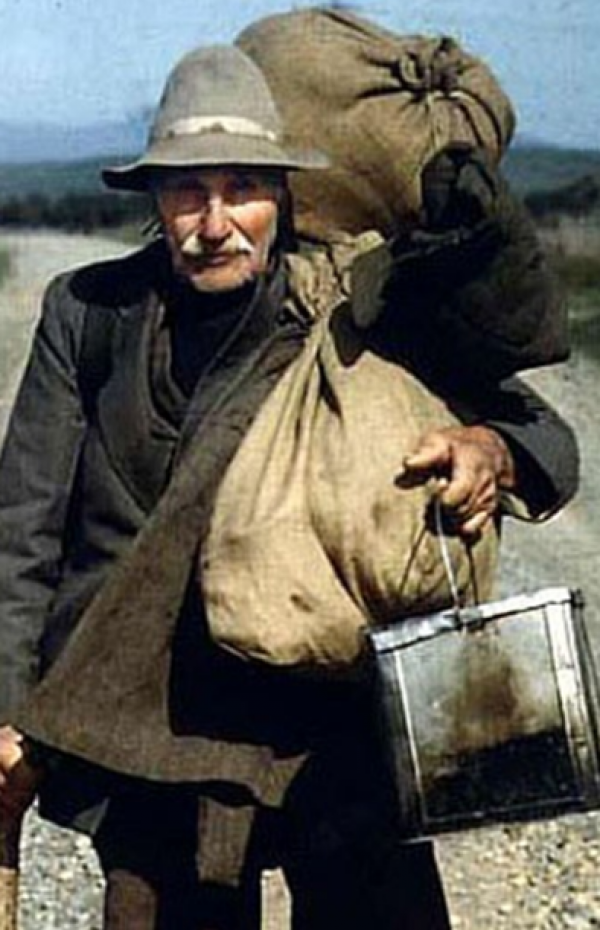
For 53 years the man known to rural folk in Manawatu, Rangitikei and Wairarapa as Russian Jack was a familiar sight on country roads. He is now standing proudly and instantly recognisable in a display at the Coach House Museum in Feilding.
The display is largely the work of Feilding man Len Gray who has had vast experience here and overseas in set and stage design. He has spent the last 12-18 months working on the project. The much modified mannequin which is the basis of the display stood in Mr Gray’s lounge for many months before eventually being set up at the museum. Once the decision was made to create the display Mr Gray was on the hunt for clothing and accessories to make sure it was authentic.
“I didn’t want to do just a mannequin,” Mr Gray said. “I wanted it to be a professional job. I wanted it to be a piece of art.’’
Fortunately he had some colour photographs to work from. He sourced the coat, hat and trousers from the Feilding Little Theatre, the museum had a suitable pair of boots and when the call went out for some sugar sacks and chaff sacks they too were forthcoming.
The mannequin Mr Gray had to work with was 182cm tall (6ft) but Russian Jack was only 167cm (5ft 6in). So Mr Gray had to modify it by taking centimetres off the midriff and the shin bones. He also had to create new hands because the mannequin’s hands were too feminine. One of Russian Jack’s distinguishing features was his neatly trimmed moustache. To replicate that, Mr Gray knew just what to do.
“When I had a haircut I just gathered up some of the hair off the floor and used that.’’
|
|
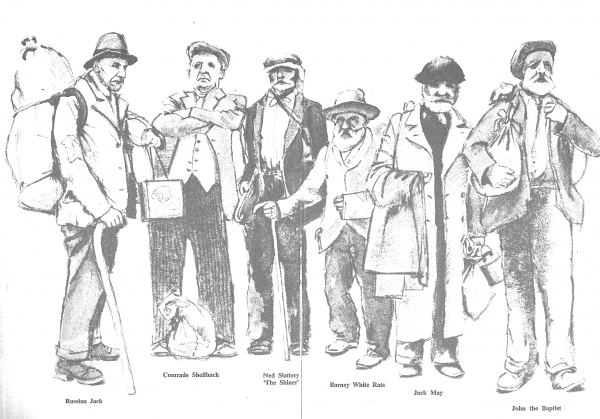
Russian Jack stands in a corner display with a dual backdrop painted by Mr Gray to represent night and day. On the nighttime scene there is a ruru or morepork on a protruding branch. On the daytime scene the ruru is replaced with a kotare or kingfisher. On the base on which the mannequin stands are some of the quotes attributed to him and the whole display is surrounded by a low fence created from well worn timber posts. A television screen features some still images of the man and a short video. “It was a challenging project but I enjoy a challenge,” Mr Gray said. “I’m really proud and pleased with how it’s turned out.’’ Russian Jack, whose real name was said to be Barrett Crummen or Krumen, arrived in New Zealand by accident in 1912 after the cargo steamer he was working on went aground off the coast of Gisborne. After making it ashore in Gisborne, he spent a short time scrub cutting before deciding he wanted to get back to sea. Not wanting to pay for a train trip to Wellington to find another ship to sign on to he decided to walk, a distance of about 500km. By the time he reached Wellington, Russian Jack reportedly had so enjoyed the experience that he decided not to go to sea again but instead to keep walking. So he did, for 53 years. He was not the only swagger on the roads around New Zealand but was probably the best known. Each night he would find a place to stay-either in a farmer’s shed or on the roadside. When he found a farm house that looked as though it might be suitable he would ask permission to sleep in a shed and offer to do some chores in exchange for a hot meal. His command of English was not great but he always managed to make himself understood. Although he had been nicknamed Russian Jack, he was actually from Latvia, but Russian was his native tongue. His walking days continued into the 1960s when he suffered a severe bout of frostbite and had to be hospitalised. Eventually he ended up in a rest home in the Wairarapa at the age of 87. He died there three years later, but he kept his boots and his walking stick under his bed, just in case he decided to hit the road again.
|